




How Do Automated Hydroponic Systems Work?
Contents
- 1 How Do Automated Hydroponic Systems Work?
- 1.1 Introduction to Automated Hydroponic Systems
- 1.2 The Basics of Hydroponics
- 1.3 Core Components of Automated Hydroponic Systems
- 1.4 How Automation Actually Works
- 1.5 Types of Automated Hydroponic Systems
- 1.6 Advantages of Automated Hydroponic Systems
- 1.7 Maintenance and Monitoring
- 1.8 Challenges and Considerations
- 1.9 The Future of Automated Hydroponics
- 1.10 Conclusion
- 1.11 Frequently Asked Questions (FAQ) — Automated Hydroponic Systems
- 1.12 Troubleshooting FAQ — Automated Hydroponic Systems
- 1.13 A Detailed Guide to The Hydroponic Drip System
- 1.14 Aeroponic vs Hydroponic Systems: A Comparative Guide
- 1.15 DWC Hybrid System
Introduction to Automated Hydroponic Systems
Automated hydroponic systems represent one of the most innovative advances in modern agriculture and indoor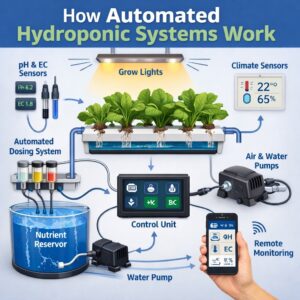 gardening. By combining traditional hydroponic principles with automation technology, these systems remove much of the manual labour associated with plant cultivation while improving efficiency, yield, and consistency.
Instead of relying on soil, hydroponics grows plants in nutrient-rich water solutions, and automation ensures plants receive precisely what they need at the right time. Understanding how these systems work helps growers—from hobbyists to commercial farmers- make informed decisions about adopting this technology.
The Basics of Hydroponics
At its core, hydroponics is a method of growing plants without soil. Instead, plant roots are supported by an inert medium such as rockwool, perlite, clay pellets, or coconut coir. Nutrients normally found in soil are dissolved in water and delivered directly to the roots. This allows plants to absorb nutrients more efficiently, often resulting in faster growth and higher yields.
Traditional hydroponic systems may require frequent manual monitoring of water levels, nutrient concentrations, and environmental conditions. Automated systems enhance this process by using sensors, controllers, and pumps to maintain optimal growing conditions with minimal human intervention.
Core Components of Automated Hydroponic Systems
Automated hydroponic setups consist of several integrated components working together:
-
-
- Reservoir
This tank holds the nutrient solution that feeds the plants. Automation systems often monitor reservoir levels and may automatically refill or adjust nutrient concentration. - Water Pump
Pumps circulate the nutrient solution through the system. Automated timers or controllers regulate when pumps turn on and off, ensuring roots receive consistent hydration. - Sensors
Sensors measure critical variables such as pH levels, electrical conductivity (EC), temperature, humidity, and water levels. These readings allow the system to make real-time adjustments. - Grow Lights
In indoor environments, automated lighting systems simulate sunlight. Timers or smart controllers regulate light intensity and duration according to plant growth stages. - Control Unit
The control unit is the system’s “brain.” It processes sensor data and activates components like pumps, fans, or dosing systems. Some advanced models connect to mobile apps for remote monitoring. - Nutrient Dosing System
Automated dosing systems add precise amounts of nutrients to maintain optimal solution strength. This prevents underfeeding or nutrient burn.
- Reservoir
-
How Automation Actually Works
Automation in hydroponics is based on feedback loops. Sensors continuously collect environmental and nutrient data and send it to the controller. The controller compares these readings to preset parameters. If a value falls outside the ideal range, the system automatically adjusts conditions.
For example, if a pH sensor detects that the nutrient solution is too acidic, the controller can activate a dosing pump to add a pH-balancing solution. If water levels drop, a float sensor may trigger a refill valve. If temperatures rise above a set limit, fans or cooling systems activate.
This constant monitoring and adjustment create a stable environment where plants can thrive without stress. Stability is crucial because sudden changes in nutrients, temperature, or moisture can stunt growth or reduce yields.
Types of Automated Hydroponic Systems
Automation can be applied to several hydroponic system designs:
Drip Systems – Nutrient solution drips slowly onto plant roots at timed intervals. Automation controls drip frequency and volume.
Deep Water Culture (DWC) – Roots are submerged in aerated nutrient solution. Automated air pumps maintain oxygen levels, while sensors regulate solution quality.
Nutrient Film Technique (NFT) – A thin film of nutrient solution flows continuously past roots. Automation maintains flow rate and nutrient balance.
Ebb and Flow (Flood and Drain) – The grow tray floods periodically and then drains. Timers control flooding cycles.
Aeroponics – Roots hang in the air and are misted with nutrient solution. Automated misting intervals are critical for success.
Each system benefits from automation because plant requirements change throughout growth stages, and precise control improves outcomes.
Advantages of Automated Hydroponic Systems
Consistency and Precision
Automation removes guesswork. Plants receive exactly the amount of nutrients, water, and light required, reducing variability between crops.
Time Savings
Growers spend less time performing routine tasks like watering, measuring nutrients, or adjusting lighting schedules.
Resource Efficiency
Automated systems use water and fertilisers more efficiently than traditional gardening. Closed-loop designs recycle unused nutrient solution.
Scalability
Automation makes it easier to scale operations. Commercial growers can manage large facilities without proportionally increasing labour.
Higher Yields
Stable growing conditions allow plants to focus energy on growth rather than stress adaptation, often resulting in faster development and greater harvests.
Smart Technology Integration
Modern automated hydroponic systems increasingly incorporate smart technology. Wi-Fi or Bluetooth connectivity allows growers to monitor system performance through mobile apps or web dashboards. Alerts can notify users if conditions fall outside safe ranges, enabling quick intervention even when away from the grow site.
Some advanced setups integrate artificial intelligence to analyse plant growth patterns and optimise environmental conditions automatically. Over time, these systems can “learn” what works best for specific plant varieties and adjust settings accordingly.
Maintenance and Monitoring
Despite automation, these systems are not entirely hands-off. Routine maintenance is still necessary to ensure reliability. Growers must periodically clean reservoirs, check tubing for blockages, calibrate sensors, and inspect pumps. Automation reduces daily workload but does not eliminate the need for oversight.
Regular monitoring also helps detect issues such as algae growth, nutrient imbalances, or equipment wear before they affect plant health.
Challenges and Considerations
While automated hydroponic systems offer many advantages, they also come with certain challenges:
-
-
- Initial Cost: Automated setups are typically more expensive than manual systems due to sensors, controllers, and dosing equipment.
- Technical Knowledge: Users must understand system settings, calibration, and troubleshooting.
- Power Dependence: Most automated systems rely on electricity; outages can disrupt operation unless backup systems are installed.
-
Careful planning and system design can minimise these risks.
The Future of Automated Hydroponics
As technology advances, automated hydroponic systems are becoming more accessible and affordable. Innovations in sensor technology, data analytics, and smart controls are making it easier for individuals and businesses to grow food efficiently in limited spaces. Urban farming, vertical agriculture, and controlled-environment farming all rely heavily on automation to produce fresh crops year-round.
These systems are also gaining attention for their sustainability benefits. By using less water, reducing fertiliser waste, and enabling local production, automated hydroponics supports more environmentally responsible food systems.
Conclusion
Automated hydroponic systems operate by combining soilless cultivation with intelligent technology that monitors and adjusts growing conditions in real-time. Through sensors, controllers, pumps, and dosing mechanisms, they create a stable environment where plants can flourish with minimal manual effort.
Whether used by home gardeners or commercial growers, these systems represent a significant step forward in efficient and sustainable agriculture. As technology continues to evolve, automation is likely to become a standard feature of modern plant cultivation.
Frequently Asked Questions (FAQ) — Automated Hydroponic Systems
1. What is an automated hydroponic system?
An automated hydroponic system is a plant-growing setup that uses sensors, timers, pumps, and controllers to automatically manage watering, nutrients, lighting, and environmental conditions without constant manual input.
2. How is it different from traditional hydroponics?
Traditional hydroponics requires growers to manually monitor and adjust conditions. Automated systems perform these tasks automatically based on real-time data, improving precision and reducing labour.
3. Do automated hydroponic systems need internet access?
Not necessarily. Many systems work offline using built-in controllers. However, internet connectivity enables remote monitoring, app alerts, and data tracking.
4. Are automated systems suitable for beginners?
Yes. While setup can be slightly technical, many modern kits are designed for beginners and include pre-configured settings. Automation often makes growing easier than manual methods once installed.
5. What plants grow best in automated hydroponics?
Leafy greens, herbs, strawberries, tomatoes, peppers, and many small fruiting plants thrive. Fast-growing crops typically show the best results.
6. How often does maintenance need to be done?
Basic maintenance, such as cleaning reservoirs, checking pumps, and calibrating sensors, is usually needed every 1–3 weeks, depending on system size and usage.
7. Do automated systems use a lot of electricity?
Most home systems use relatively little power. The main energy draw comes from grow lights and pumps, but efficient LED lighting keeps electricity consumption low.
8. What happens if there’s a power outage?
During an outage, pumps and automation stop working. Short outages usually don’t harm plants, but longer ones can. Many growers use battery backups or surge protectors for protection.
9. Are automated hydroponic systems water-efficient?
Yes. They typically use far less water than soil gardening because excess nutrient solution is recirculated instead of lost through drainage or evaporation.10. Is automation worth the cost?
For many growers, yes. Although the upfront cost is higher, automation saves time, reduces errors, increases yields, and often pays off through improved productivity and reduced waste.
10. Is automation worth the cost?
For many growers, yes. Although the upfront cost is higher, automation saves time, reduces errors, increases yields, and often pays off through improved productivity and reduced waste.
Troubleshooting FAQ — Automated Hydroponic Systems
1. Why are my plants turning yellow?
Yellowing leaves often indicate nutrient deficiencies, incorrect pH levels, or poor oxygenation. Check that your nutrient solution is properly mixed, pH is within the recommended range (usually 5.5–6.5), and air pumps are functioning.
2. What causes slow plant growth in automated systems?
Slow growth may result from insufficient light, low nutrient concentration, incorrect temperature, or root stress. Verify lighting duration, nutrient strength (EC levels), and environmental conditions.
3. Why does my system smell bad?
Unpleasant odours usually indicate bacterial growth, stagnant water, or root rot. Clean the reservoir, replace the nutrient solution, and ensure proper aeration and circulation.
4. My sensors show inconsistent readings. What should I do?
Sensors may need calibration or cleaning. Mineral buildup can affect accuracy, so gently clean probes and recalibrate according to manufacturer instructions.
5. Why is algae growing in my system?
Algae forms when light reaches the nutrient solution. Use opaque tubing and covered reservoirs to block light exposure, and clean affected parts regularly.
6. What should I do if the pump stops working?
First check power connections, fuses, and timers. If the pump is clogged, clean the intake. Keeping a spare pump on hand is recommended for emergencies.
7. Why are my plant roots turning brown?
Brown roots often signal root rot caused by warm water, low oxygen, or pathogens. Lower water temperature, increase aeration, and replace the contaminated solution.
8. How do I fix pH levels that keep fluctuating?
Frequent pH swings may indicate unstable nutrient mixtures, contaminated water, or poor-quality nutrients. Use filtered water and high-quality nutrients, and recalibrate pH sensors.
9. Why is my system using more water than expected?
Higher water usage can occur if plants are larger, temperatures are higher, or leaks exist. Inspect tubing and fittings for leaks and ensure environmental controls are working.
10. Can automation fail, and how do I prevent problems?
Yes, automation relies on equipment that can wear out. Prevent issues by performing routine maintenance, testing backup systems, cleaning components, and monitoring alerts from your controller.