




Understanding Deep Water Culture, Floating, and Hybrid Hydroponic Systems
Deep Water Culture
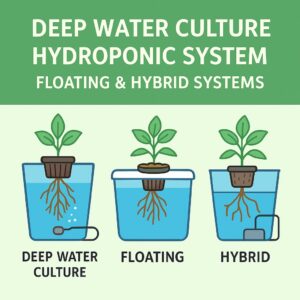
Deep Water Culture, often referred to as DWC, is one of the simplest and most efficient hydroponic methods available. In this system, plant roots are suspended directly in a nutrient-rich, oxygenated water solution. Because the roots are constantly submerged, plants have uninterrupted access to oxygen, water, and nutrients, allowing for faster and healthier growth.
How Deep Water Culture Works
In a DWC setup, plants are typically placed in net pots filled with a growing medium such as clay pebbles or rockwool. These pots are positioned in holes on the lid of a reservoir that holds the nutrient solution. An air pump and air stone are used to continuously oxygenate the water, preventing the roots from suffocating.
Advantages
-
-
- Fast Growth: Constant access to oxygen and nutrients leads to accelerated plant development.
- Low Maintenance: Once set up, a DWC system requires little daily effort.
- Cost-Effective: Ideal for beginners, it requires minimal components and can be built with household materials.
- Clean and Efficient: No soil means fewer pests and diseases, and no messy cleanup.
-
Disadvantages
-
-
- Temperature Sensitivity: The water temperature must be maintained between 18°C–24°C to prevent root rot.
- Power Dependency: Air pumps and oxygenation devices require electricity.
- Nutrient Balance: Incorrect nutrient levels can quickly affect plant health due to direct root exposure.
-
Best Suited For
DWC systems are excellent for growing leafy greens, herbs, and small fruiting plants like lettuce, basil, and strawberries. They are perfect for home growers, hobbyists, and classroom projects.
Floating Hydroponic System:
Simple and Scalable
The DWC Floating System, sometimes called a Raft System, is a close relative of Deep Water Culture. The main difference lies in how the plants are supported and how the system scales for larger setups. It’s a popular choice for commercial growers and large-scale food production.
How a Floating Hydroponic System Works
In a floating hydroponic system, plants are placed on a floating raft (often made from polystyrene or foam) that rests on top of a tank or reservoir filled with nutrient solution. The raft moves gently with water currents, ensuring even nutrient exposure. Like DWC, air stones are used to keep the solution oxygenated.
This method is widely used in commercial lettuce and herb farms, particularly because it supports high plant density and can be easily expanded.
Advantages
-
-
- Scalable for Large Operations: Ideal for commercial farms and greenhouses.
- Uniform Growth Conditions: Nutrients and oxygen are evenly distributed.
- Energy Efficient: Requires minimal energy compared to other hydroponic systems.
- Stable Water Levels: Plants stay at the same height relative to the nutrient solution, maintaining consistency.
-
Disadvantages
-
-
- Limited Crop Variety: Best suited for lightweight, short-rooted plants.
- Monitoring Required: Nutrient levels and pH must be regularly checked.
- Potential Algae Growth: Exposure to light can encourage algae in the reservoir.
-
Best Suited For
Floating systems are perfect for lettuce, spinach, kale, and herbs such as parsley or cilantro. They’re a favourite among commercial growers looking for an affordable, high-yield hydroponic method.
Hybrid Hydroponic Systems:
Combining the Best of Both Worlds
A Hybrid Hydroponic System blends features from multiple hydroponic methods, such as Deep Water Culture, Nutrient Film Technique (NFT), and Aeroponics, to create a highly adaptable and efficient growing environment.
How a Hydroponic System Works
In hybrid setups, plants may have roots partially submerged in nutrient solution (like DWC) while also receiving a thin film of moving nutrients (like NFT) or periodic misting (like aeroponics). This dual exposure ensures that plants get both oxygen and nutrients in optimal amounts.
For example, some hybrid systems combine DWC’s oxygen-rich water with drip irrigation to prevent stagnation and boost nutrient delivery. These systems can be automated with timers, sensors, and pumps for precision growing.
Advantages
-
-
- Customisable: Growers can design systems tailored to their specific crops and space.
- Increased Efficiency: Combines the strengths of multiple hydroponic techniques.
- Higher Yields: Plants grow faster and stronger with balanced access to nutrients and oxygen.
- Technology Friendly: Works well with automation, sensors, and smart monitoring tools.
-
Disadvantages
-
-
- Complex Setup: Requires more equipment and monitoring than basic systems.
- Higher Cost: Initial investment is greater, though offset by long-term yields.
- Technical Knowledge: Some understanding of hydroponic principles is needed.
-
Best Suited For
Hybrid systems are excellent for serious hobbyists, research institutions, and commercial growers who want maximum control and productivity. They’re ideal for tomatoes, cucumbers, peppers, and flowering plants that require both robust root support and high oxygenation.
Choosing the Right Hydroponic System
Selecting the right hydroponic method depends on your space, budget, and crop goals.
|
System |
Ideal For |
Skill Level |
Cost |
Common Crops |
|
Deep Water Culture |
Home & hobby growers |
Beginner |
Low |
Lettuce, basil, spinach |
|
Floating System |
Commercial production |
Intermediate |
Medium |
Kale, herbs, leafy greens |
|
Hybrid System |
Advanced & commercial |
Advanced |
High |
Tomatoes, peppers, cucumbers |
If you’re new to hydroponics, start with a simple DWC setup. It’s easy to maintain and highly rewarding. As you gain experience, explore floating or hybrid systems to scale your production and experiment with more complex crops.
Final Thoughts
Hydroponic systems like Deep Water Culture, Floating, and Hybrid Setups are transforming the way we grow food. By removing soil from the equation and optimising nutrient delivery, growers can produce faster, cleaner, and more sustainable crops year-round.
Whether you’re a home gardener wanting to grow fresh greens or a commercial farmer aiming for consistent yields, hydroponics offers a smart, scalable solution for the future of agriculture.
Pingback: The Different Kinds of Hydroponic Systems - Laa Dee Daa